Thursday, March 14, 2013

Patanjali Samadhi

                The Jeeva Samadhi of Patanjali Maharishi is believed to be in Tirupattur Brahmapureeswarar Temple (30 km from Trichy), where Lord Brahma installed 12 Shiva Lingams and worshipped Lord Shiva to get back his Tejas.

                Shankaracharya's guru had told Shankaracharya that Patanjali was reincarnated as Govinda Bhagavatpada and was meditating in a cave somewhere in the state of samadhi.

Wednesday, March 13, 2013

Tamil Shaivite legend

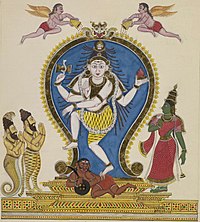
The tiger-footed Vyaghrapada and snake-footed Patanjali salute Nataraja.
 
                   Regarding his early years, a Tamil Shaiva Siddhanta tradition from around 10th Cent. AD holds that Patañjali learned Yoga along with seven other disciples from the great Yogic Guru Nandhi Deva, as stated in Tirumular's Tirumandiram (Tantra 1).
Nandhi arulPetra Nadharai Naadinom Nandhigal Nalvar Siva Yoga MaaMuni Mandru thozhuda Patañjali Vyakramar Endrivar Ennodu (Thirumoolar) Enmarumaame
Translation
We sought the feet of the Lord who graced Nandikesvara
The Four Nandhis,
Sivayoga Muni, Patañjali, Vyaghrapada and I (Thirumoolar)
We were these eight.
                       The ancient Kali Kautuvam also describes how Patañjali and Vyagrapada gathered along with the gods in Thillai near Chidambaram to watch Shiva and Kali dance and perform the 108 mystic Karanas, which formed the foundation for the system of Natya Yoga. He has also written Charana Shrungarahita Stotram on Nataraja.

                        This Tamil tradition also gives his birthplace in South Kailash - Koneswaram temple, Trincomalee. Some other traditions feel that his being born in Bharatavarsha - the part of the ancient world corresponding to South Asia - is beneath his godlike status, and that he must have been born in the Jambudvipa, the mythical center of the universe.

Patañjali as Siddha is also mentioned by the goldsmith-sage Bogar:
It was why my Grandfather who said, "Climb and see."
But it was Kalangi Nathar who gave me birth.
Patañjali,Viyagiramar,and Sivayogi Muni all so rightly said,
"Look! This is the path!" - Bhogar 7000 (translation by Layne Little)
This tradition also holds that Patañjali was a master of dance.

Hagiography -Patañjali

                     In the Yoga tradition, Patañjali is a revered name and has been deified by many groups, especially in the Shaivite bhakti tradition. It is claimed that Patañjali is an incarnation of Ādi Śeṣa, who is the first ego-expansion of Viṣṇu, Sankarshana. Sankarshana is part of the so-called caturvyūha, the fourfold manifestation of Vishnu. Patañjali is considered an incarnation of God defending the yoga. He is called Maharshi.

                           In one popular legend, Patañjali was born to Atri and his wife Anasuya (this would make him go back to the time of the creation by Brahma). According to this tradition, Anasuya had to go through a stern test of her chastity when the Trimurti themselves came as Bhikshuks and asked her for Bhiksha. She passed their test by accepting them as her children and fed them. She got the boon where all the three Murtis will be born to them. They were Soma Skandan or Patañjali, Dattatreya, and Durvasa.

Monday, March 11, 2013

Patanjali - Authorship

Patañjali - Modern art rendering in Patanjali Yogpeeth, Haridwar
 
 
                       Whether the two works, the Yoga Sutras and the Mahābhāṣya, are by the same author has been the subject of considerable debate. The authorship of the two is first attributed to the same person in Bhojadeva's Rajamartanda, a relatively late (10th Cent.) commentary on the Yoga Sutras, as well as several subsequent texts. As for the texts themselves, the Yoga Sutra iii.44 cites a sutra as that from Patanjali by name, but this line itself is not from the Mahābhāṣya. This 10th Century legend of single-authorship is doubtful. The literary styles and contents of the Yogasūtras and the Mahābhāṣya are entirely different, and the only work on medicine attributed to Patañjali is lost. Sources of doubt include the lack of cross-references between the texts, and no mutual awareness of each other, unlike other cases of multiple works by (later) Sanskrit authors. Also, some elements in the Yoga Sutras may date from as late as the 4th Cent. AD, but such changes may be due to divergent authorship, or due to later additions which are not atypical in the oral tradition. Most scholars refer to both works as "by Patanjali", without meaning that they are by the same author.

                       In addition to the Mahābhāṣya and Yoga Sūtras, the 11th Century commentary on Charaka by the Bengali scholar Cakrapāṇidatta, and the 16th Cent. text Patanjalicarita ascribes to Patañjali a medical text called the Carakapratisaṃskṛtaḥ (now lost) which is apparently a revision (pratisaṃskṛtaḥ) of the medical treatise by Caraka. While there is a short treatise on yoga in the medical work called the Carakasaṃhitā (by Caraka), towards the end of the chapter called śārīrasthāna, it is notable for not bearing much resemblance to the Yoga Sūtras, and in fact presenting a form of eightfold yoga that is completely different from that laid out by Patañjali in the Yoga Sūtras and the commentary Yogasūtrabhāṣya.
The tradition that holds that all three works are by the same author is summed up in this verse from the beginning of Bhoja's Rājamārttanda commentary on the Yoga Sūtras:
yogena cittasya, padena vācāṃ, malaṃ śarīrasya ca vaidyakena
yo'pākarot taṃ pravaraṃ munīnāṃ patañjaliṃ prāñjalir ānato'smi
पतञ्जलिप्रार्थनं॥ योगेन चित्तस्य पदेन वाचां मलं शरीरस्य च वैदिकेन । योपाकरोत्तं प्रवरं मुनीनां पतञ्जलिं प्राञ्जलिरानतोस्मि॥
English translation: I bow with my hands together to the eminent sage Patañjali, who removed the impurities of the mind through yoga, of speech through grammar, and of the body through medicine.

Friday, March 8, 2013

Patanjali

                  Patañjali (Tamil: பதஞ்ஜலி, Sanskrit: पतञ्जलि) is the compiler of the Yoga Sūtras, an important collection of aphorisms on Yoga practice. According to tradition, the same Patañjali was also the author of the Mahābhāṣya, a commentary on Kātyāyana's vārttikas (short comments) on Pāṇini's Aṣṭādhyāyī and of an unspecified work of medicine (āyurveda). Patanjali's place of birth is held to be "Gonarda" (Thiru-Gona-Malai), a "country in the east" and he described himself as a "Gonardiya" throughout his life. This corroborates Tirumular's Tirumandhiram, which describes him as hailing from Then Kailasam (Koneswaram temple, Trincomalee), and he famously visited the Thillai Nataraja Temple, Chidambaram, where he wrote the Charana Shrungarahita Stotram on Nataraja. In recent decades, the Yoga Sutra has become quite popular worldwide for the precepts regarding practice of Raja Yoga and its philosophical basis. "Yoga" in traditional Hinduism involves inner contemplation, a system of meditation practice and ethics.

The 18 siddhars

There are 18 siddhars in the Tamil siddha tradition. They are
  1. Sri Patanjali Siddhar
  2. Sri Agastya Siddhar
  3. Sri Kamalamuni Siddhar
  4. Sri Thirumoolar Siddhar
  5. Sri Kuthambai Siddhar
  6. Sri Korakkar Siddhar
  7. Sri Thanvandri Siddhar
  8. Sri Konganar Siddhar
  9. Sri Sattamuni Siddhar
  10. Sri Vanmeegar Siddhar
  11. Sri Ramadevar Siddhar
  12. Sri Nandeeswarar (Nandidevar) Siddhar
  13. Sri Edaikkadar Siddhar
  14. Sri Machamuni Siddhar
  15. Sri Karuvoorar Siddhar
  16. Sri Bogar Siddhar
  17. Pambatti Siddhar
  18. Sundarandandar
All Siddhars were among the highest disciples of God Shiva, and are considered equal in their powers and devotion to the supreme God.

Wednesday, March 6, 2013

Siddhars (Tamil: சித்தர்)

              Siddhars (Tamil: சித்தர்) are saints in India, mostly of the Saivaite denomination in Tamil Nadu, who professed and practised an unorthodox type of Sadhana, or spiritual practice, to attain liberation. Yogic powers called Siddhis are acquired by constant practice of certain yogic disciplines. Those who acquire these Siddhis are called Siddhas. These sidhars can be compared to Mystics of the western civilization. Siddhars are people who are believed to control and transcend the barriers of time and space by meditation (Yoga), after the use of substances called Rasayanas that transform the body to make it potentially deathless, and a particular breathing-practice, a type of Pranayama. Through their practices they are believed to have reached stages of insight which enabled them to tune into the powers hidden in various material substances and practices, useful for suffering and ignorant mankind. Typically Siddhars were saints, doctors, alchemists and mysticists all at once. They wrote their findings, in the form of poems in Tamil language, on palm leaves which are collected and stored in what are known today as Palm leaf manuscript, today still owned by private families in Tamil Nadu and handed down through the generations, as well as public institutions such as Universities all over the world .

            In this way Siddhars developed, among other branches of a vast knowledge-system, what is now known as Siddha medicine, practised mainly in Tamil Nadu as Traditional native medicine. A rustic form of healing that is similar to Siddha medicine has since been practised by experienced elderly in the villages of Tamil Nadu. (This has been misunderstood as Paatti Vaitthiyam, Naattu marunthu and Mooligai marutthuvam. While paati vaitthiyam or naatu marunthu is traditional Tamil medicine and mooligai marutthuvam is ayurvedic medicine.) They are also founders of Varmam - a martial art for self-defence and medical treatment at the same time. Varmam are specific points located in the human body which when pressed in different ways can give various results, such as disabling an attacker in self-defence, or balancing a physical condition as an easy first-aid medical treatment.

                 Tamil Siddhars were the first to develop pulse-reading ("naadi paarththal" in Tamil) to identify the origin of diseases. This method was later copied and used in ayurvedha.

                  Siddhars have also written many religious poems. It is believed that most of them have lived for ages, in a mystic mountain called Sathuragiri, near Thanipparai village in Tamil Nadu.

                   One of the best-known Siddhars was Agasthyar or Agasthya, who is believed to be the founding father of Siddha culture.

                    Abithana Chintamani states Siddhars are either of the 9 or 18 persons enlisted, but sage Agastyar states that there are many who precede these and follow 9 or 18 persons. Many of the great Siddhars are regarded to have powers magical and spiritual.